
The best marketing doesn’t feel like marketing is doing rounds on the internet. You must have come across this phrase as well.
Your buyers know they are surrounded by marketing messages trying to change their behavior, and purchasing choices.
They are well aware and hence a lot of marketing has become obvious.
Which makes it obvious that you have to stand out to survive.
And one among many ways to stand out in an over-saturated or crowded market, you have to delight your customers.
Today, I’ll share a one-time tested framework created by Dr. Haruki Kano that can help you give regular dopamine spikes to your customers.
What is the Kano Model?
The Kano Model is a 1980s framework designed by Professor Noriaki Kano for developing products that increase customer satisfaction.
His framework categorizes features of a product into five different categories depending on their impact on customer satisfaction.
The Kano Model is pretty straightforward and easy to understand. Plus, to make it more relatable, I’m considering an article as a product. It will help you drive the point home faster.
The five main components of the Kano Model are:
- Must-Have
- Linear
- Delighter
- Indifference
- Reverse
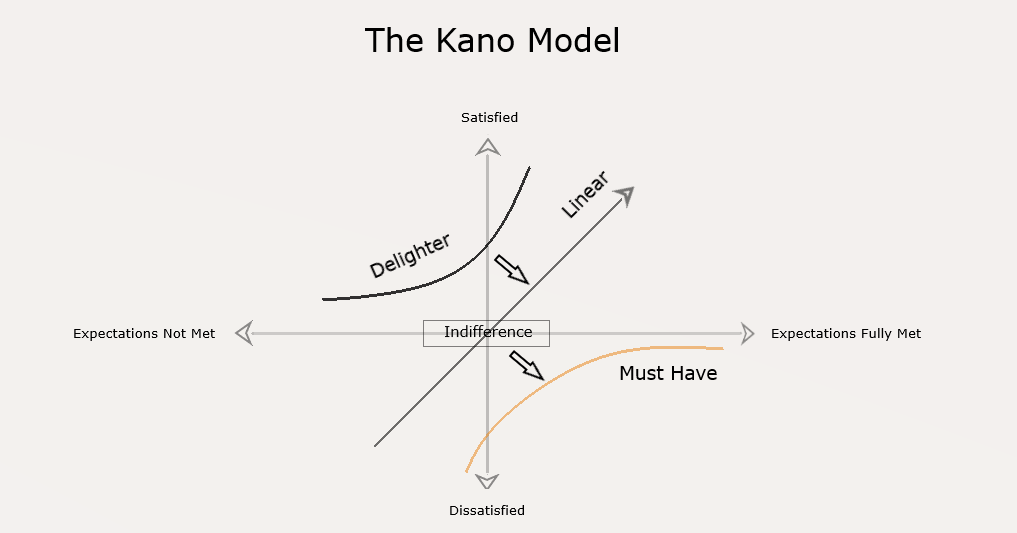
1. Must-Haves
These are the features that every visitor expects to be present in your article. So, If you include them, you don’t move your visitors’ satisfaction needle whatsoever.
But god forbid if you forget to include them — your visitors’ satisfaction will nose dive.
For example, are you going to purchase a car that is doing rounds on news of a malfunctioning steering wheel?
No — you won’t consider such a car. If you can’t steer it properly, the vehicle has no utility! It is a must-have.
For an article, below is a quick checklist of must-have features:
- Proper Grammar
- Easy to understand
- The body delivers what the title promises
- Easy to read (font type and size)
- Skimmable
- Easy to share
- No ads
- Relevant images
- You can add more…….
2. The performance or Linear Features
These are the ones your visitors are looking for. These are at the top of their mind when they land on your article.
If you add/execute the linear features really well, it leads to an increase in your visitors’ delight and satisfaction. Also, the more linear features you add, the more is the satisfaction of your visitor.
Below is a checklist of linear features for an article:
- Real-life examples
- Corroborative/relevant statistics
- The lead of an article
- Easy to grasp takeaway
- Useful & Actionable information
- Engaging story
- Fun fact and Anecdotes
- You can add more…….
3. Delighters
You might have understood what these features do. These are the ones that you offer to your visitors when they aren’t expecting them whatsoever. If you implement these features well, you skyrocket your visitor’s delight.
And what if they aren’t present in your article?
Nothing happens. There is no adverse effect. Because no one was expecting them to be there, their absence makes no difference.
Below is my small checklist of delighters for an article. And as always, you can add more:
- Makes them dream more
- Gives actionable ways to achieve their dreams
- Engage their senses – vividly
- Surprises or shocks them
- Provides deep insights
- Helps learn and implement at the same time
- Cerebral
- Helps them see a topic from a different perspective
- Fun facts and Anecdotes
4. Reverse
These basically are items from your not-to-do list. Their presence hurts your visitors’ delight.
These could be:
1. Cheap psych tricks
2. Stock images
3. Blatant plagiarism
4. Anything that you think is awful like guilt-tripping your reader, etc…
5. Indifference
Indifferent: These are the features that don’t change customers’ satisfaction regardless if you execute these features perfectly or not. Collapsible FAQs on websites, for example.
Everything aside, the best thing Kano Model offers is a framework to continuously innovate our content, ads, website, and other marketing activities.
How? Let’s find out:
How Does the Kano Model Help You Innovate?
Can you see the arrows pointing from delighter towards must-have? Now, what does this tell us? It means that with time, your delighters will transform into linear features, and slowly they will become the must-have.
A classic example to understand this phenomenon is your smartphone. There was a time when people would have purchased a phone without a camera. Today, if a phone has no camera, forget buying, nobody is gonna even consider such a phone.
Thus, as soon as your delighter becomes a linear feature, you have to start thinking about a new delighter. That way you continuously innovate in your marketing.
Also, the Kano Model tells us that every new cool feature comes with an expiry date. And the arrival of the expiry date is directly proportional to how fast others adopt the new cool feature.
Key Takeaway
- Make sure all must-haves are there to achieve even an “indifferent” level of satisfaction.
- Give a lot of linear features for a high level of satisfaction.
- Try to give even a half-baked delighter. It can skyrocket satisfaction